Cultivating Motivation
Why talent alone doesn't sustain improvement, how Self-Determination Theory's autonomy, relatedness, and competence feed intrinsic motivation, and how that maps onto deliberate practice for golfers who feel plateaued.
People with talent are more likely to quit what they’re good at. This makes sense; we crave challenge. The ‘natural’ that developed their skill and stays actively motivated to improve is exceptionally rare. But if you dig into the history, many of those we say have talent actually had a struggle to get great. Michael Jordan is the classic example.
While Jordan’s history gets exaggerated sometimes, one of the main points of his success came down to his relentless practice of free-throws. He brute-forced hours just to get better. He worked his way to great because he loved the game so much. He also had enough skill to provide a base.
Similarly, people say Einstein failed math, which is not entirely true. What is true in both cases (and many more) is that they worked to get better at something that they loved. Even though–maybe even because–it did not come entirely easy to them.
So what is the magic that keeps people motivated?
The short answer is: having a long term goal and knowing that you can achieve it.
Self-Determination Theory
According to the Self-Determination Theory (Deci & Ryan), there are three psychological needs to predict sustained motivation:
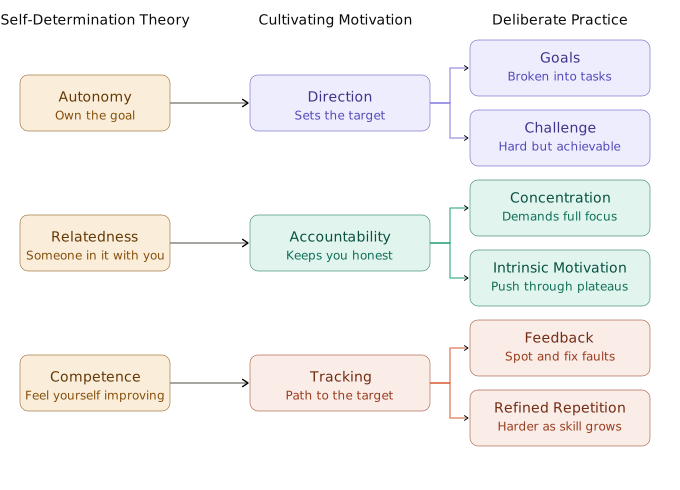
- Autonomy - Feeling that you are in control of your actions (I am choosing to practice, versus my coach is making me)
- Relatedness - Connection and support from others as sharing struggle reinforces commitment
- Competence - Recognizing competence and that improvement is possible
When these needs are fulfilled (the value of each varying by individual) it is easier for motivation to be intrinsic. That means you are predominately doing the work for you, not external factors. It is the intrinsic motivation that leads to long-term motivation. Intrinsic motivation is a key element of deliberate practice, as defined by psychologist K. Anders Ericsson.
Deliberate Practice
Deliberate practice is a training framework designed to optimize the path to mastery of skills. We’re all familiar with the 10,000-Hour Rule popularized by Malcolm Gladwell in Outliers. Deliberate practice, in part challenged that rule by better trying to figure out why some individuals excel more rapidly than others. The results of a study of elite student violinists, conducted by K. Anders Ericsson, Ralf Krampe, and Clemens Tesch-Römer, identified elements, which can be summarized as:
- Goals - Specific goals that can be broken down and managed as tasks
- Challenge - Tasks should be outside of your comfort zone, yet achievable
- Concentration - Task should require intense focus
- Feedback - Immediate information, such as a coach, recording, or self-reflection to spot and fix faults
- Refined Repetition - Increasing difficulty, based on ability growth, to maintain challenge
- Intrinsic Motivation - Self-desire to improve and achieve goals, despite struggles and plateaus
Staying Motivated
In order to stay motivated, we adhere to three main drivers:
- Direction - Desired and achievable long-term goal(s), ideally supported by supporting goals
- Accountability - Recognizing that you are in control of your performance (intrinsic motivators/goals) and have the ability to improve (self-efficacy/confidence)
- Traceability - Measurable outcomes that can be used to track strengths, weaknesses, and progress, through data metrics and/or journaling (see Golf Better Everyday on why the act of measuring changes behavior on its own)
This may sound like a simplified version of deliberate practice. But that is part of what makes deliberate practice so effective–goal, challenge, feedback loop, repeat.
Motivation for Advanced Golfers
Better golfers have generally been playing for years. It is common for these players to feel like their game has plateaued. It is also common for them to think that they are working to improve, but aren’t doing the right things.
The formula doesn’t change when you get better. You can still be better and the same steps will get you there. Set goals. Track your game–the good and the bad. Address your weaknesses without neglecting reinforcement of your strengths. Figure out where you are extrinsically motivated and see if you can change that motivator to an intrinsic goal. (For more on why performance goals can backfire and how to reframe them as learning goals, see To Goal or Not to Goal.)
Many of these players will frequently rotate equipment, even though they know it is more about the player than new gear. Part of why new equipment (or a different grip/swing thought/etc.) appears to work is because it forces a change. Our bodies and minds are lazy and need to be challenged to grow.
Many will work endlessly with a coach or coaches. The biggest gripe of physical therapists is people showing up once a week, not having done their assigned exercises and getting frustrated that they aren’t fixed. If your coach doesn’t have an improvement plan for you, if they are just fixing the fault of the day, you either need to set and communicate goals or get a new coach.
A good coach should have an improvement plan and be giving you homework. A good student does their homework. Improvement doesn’t come from making pretty shots one day. It is about changing your shot in a way that can transfer onto the golf course.
My best lessons were the ones immediately after a round of golf played with my coach. He watched me on the course, didn’t try to change anything in the moment, and showed up with a plan the next lesson. Remember, feel versus real, just because we report a fault doesn’t mean it is a direct symptom of the root cause. Help your coach help you–give them more and better information.
Summary
Motivation may be the single biggest factor in predicting success. Usually confidence, or self-efficacy, gets credit, but if you aren’t actually psyched to play and/or practice, what use is that confidence?
If we have goals, commit to working weaknesses, and track results, you are likely staying intrinsically motivated. Furthermore, you are quite likely developing your skills in an ideal manner. With small steady gains you can fight plateaus and keep making continual improvements. For help getting your goals into a shape that actually sustains motivation, see Setting Goals and Choosing the Right Goals.
If you are interested in better understanding deliberate practice, and/or Braille, chess, London cab drivers, violin, Peak: Secrets from the New Science of Expertise by K. Anders Ericsson and Robert Pool is well worth a read.